

Environmental Management
Environmental vision
The INOAC Group respects the natural environment of our irreplaceable earth and contributes to realizing a prosperous, comfortable society through technology harmonized with our environment and environmentally responsible business activities.
Environmental policy
- We observe environmental laws and regulations, thoroughly ensure compliance, and engage in business activities that society can trust.
- We work to reduce CO2 emissions such as by saving energy, to help achieve a carbon neutral society and prevent global warming.
- We actively engage in resource conservation, waste reduction, and recycling activities, and reduce our emissions of air pollutants to contribute to a circular society.
- We properly manage chemicals that could impact the environment and seek to preserve our environment by reducing risk.
- We actively develop environmentally responsible products and services, contributing to the conservation of nature throughout the entire life cycle.
- We work to reduce our water usage through initiatives such as circular water usage to use water resources sustainably.
- We engage in environmental management, educate employees about the environment, implement environmental audits, and continue to improve.
- We contribute to establishing a sustainable society through efforts in local environmental preservation as good corporate citizens.
Organization chart
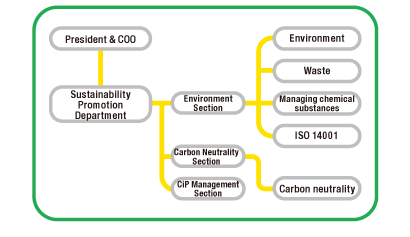
In March 2025, we established our Sustainability Promotion Department to engage in environmental activities in a more organized fashion. Under the direct control of the president, this office handles various environmental conservation activities. Within this office are the Environment Section, Carbon Neutrality Section, and CiP Management Section, under which the activities of various committees until now are linked . INOAC is now better organized to be able to tackle environmental challenges faster and in a more company-wide manner.
Internal environmental audits
We implement internal environmental audits to check the operational state of our environmental management system. The audit team consists of two to three employees who have completed the internal auditor training prescribed by the company. They check if the environmental management system is being properly operated, maintained, and improved. We create implementation guidance and revise checklists to emphasize efforts toward goal achievement and legal compliance, among other efforts to audit at a higher level.
External environmental examinations
The Japan Quality Assurance Organization (JQA), an external certification body, conducts examinations to check if our environmental management system is functioning properly in accordance with ISO 14001:2015. In September 2024 we underwent a renewal audit and our renewal was registered without anything being pointed out. Also, as overall findings, some issues were raised in terms of environmental aspects, compliance obligations and evaluations, and processes such as internal audits. We are working to improve on what was pointed out in those findings.
Summary of major activities in FY 2024
Due to factors such as increases in production volume, we were unable to achieve our goal for reducing energy consumption related to CO2 in FY 2024. However, we are continuing our CO2 reduction activities to achieve our goals for FY 2025 and beyond. Steady progress was also made in reducing environmental impact from waste, VOC, PRTR, and water intake. We had zero environmental incidents, including violations of laws and regulations.
| Initiative | Targets in FY 2024 | Achieved in FY 2024 | Targets in FY 2025 | Targets in FY 2030 | |
|---|---|---|---|---|---|
| Reducing energy consumption (in plants) |
CO2emissions (tons) | 68,631 | 76,182 | 70,010 | 45,887 |
| Reducing waste (in plants) | Amount treated (tons) | 9,500 | 9,885 | 9,027 | 8,400 |
| Reducing emissions of VOC substances | Amount emitted (kg)/ monetary sum of production (million yen) |
1.81 or less | 1.93 | 1.55 or less | 1.32 or less |
| Reducing amounts of PRTR substances emitted & transferred | Amount emitted + amount transferred (kg)/ monetary sum of production (million yen) |
2.09 or less | 2.26 | 2.19 or less | Not specified |
| Reducing water intake | Water intake (thousand m3) | 2,236 or less | 2,155 | 2,112 or less | 2,153 or less |
| Managing chemical substances | Green procurement rules revisions | Continue addressing new regulations | Revised May 14, 2024 | Continue addressing new regulations | Continue addressing new regulations |
| Preventing environmental incidents | Major accidents, legal violations,complaints (total) | 0 | 0 | 0 | 0 |
* Environment data is collected to summarize major activities from all INOAC Group business locations in Japan.
Reducing our environmental footprint
Addressing climate change (Scope 1 + 2)
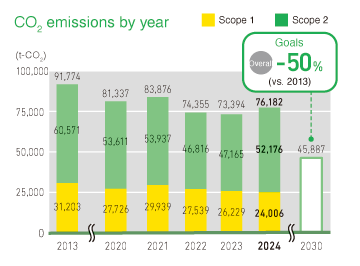
For our management to reduce Scope 1 and 2 emissions in particular, we set the goal of a 50% reduction in 2030 (overall volume in Japan) compared to 2013, and the CN Committee is leading our efforts toward this goal. Specifically, we are assigning CO2 reduction targets for each department and plant, visualizing the items to be reduced, reduction effects, and amounts of related investments, and managing the progress.
Managing chemical substances appropriately
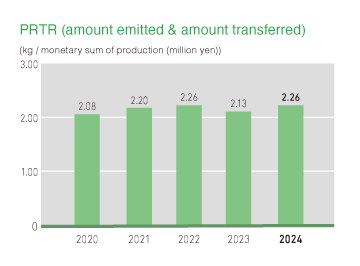
When manufacturing polyurethane foam, we use PRTR substances such as m-tolylene diisocyanate, as well as xylene and toluene which coatings contain. To reduce the amounts of these chemical substances that we handle, release, and transfer, we made progress in reducing dichloromethane which is partially left over as foaming agent, and also in both improving and taking measures against defects in its coating process. Although our total overall emissions and amount transferred of PRTR substances in FY 2024 decreased 13% vs. FY 2023, they increased by 6% in measured units.
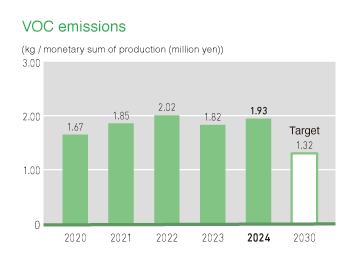
VOCs (volatile organic compounds) emitted into the air react with ultraviolet rays in sunlight, generating photochemical oxidants and airborne particulate matter. Among the raw materials that we use, VOCs contained in materials such as coatings for automotive components and adhesives are released into the air through the action of drying. To reduce VOCs, we strive to mitigate our VOC usage through means such as developing fabrication methods and processes geared toward coating efficiency and popularizing dichloromethane-free polyurethane foam technologies as we work to reduce our airborne emissions.
Initiatives to reduce waste generated
Volume of waste (excluding resalable), measured units of sales
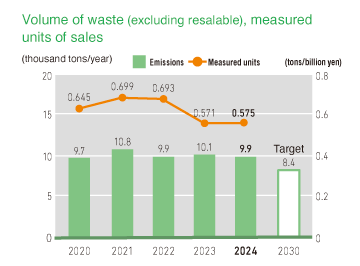
The INOAC Group (domestically) did not achieve its goal for total volume of waste discharged in FY 2024, but this volume did decrease slightly year on year. This was attributable to our ongoing activities to reduce defects and improve yield and to recycle rubber and resin materials and convert them into resalable waste. Increases in launches of new mass-produced products and prototypes and test runs involved in equipment updates were the main causes for falling short of the goal.
Approach to addressing water-related risks
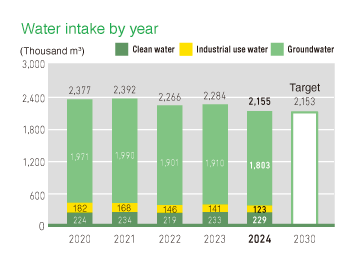

The INOAC Group consumes large volumes of water, including not only water used when manufacturing products (cooling manufacturing equipment, cooling rubber and resin molded products, etc.) but also for the water that our employees drink. We consider water to be a crucial resource. For that reason, we are working to reduce our water usage through improvements to production processes and recycling efforts. Since FY 2023, we have also been using the Aqueduct water risk assessment tool to conduct assessments of each manufacturing site and evaluate the main impacts.
Managing information on chemical substances
Observing environmental laws and regulations
The INOAC Group strives to thoroughly observe environmental laws and regulations. In FY 2024 we had zero law violations at locations in Japan and other countries. We will continue striving to preemptively prevent the occurrence of environment-related major incidents and legal violations. To thoroughly ensure compliance with environmental laws, in Japan the person in charge of environmental efforts at each location participates in Committee on Environment meetings four times per year to touch base about revisions to environmental laws and report on self-directed inspections at each location. We also strive to ensure that violations do not occur, as the Environment Section regularly conducts legal compliance inspections at locations in Japan based on ISO 14001 within our Environmental Management System.
Major environment-related laws and regulations pertaining to business activities
- Air
- Air Pollution Control Act, Automobile NOx PM Law, Act on Special Measures against Dioxins
- Water quality & soil
- Water Pollution Prevention Act, Purification Tank Act, Sewerage Act, Soil Contamination Countermeasures Act
- Noise, vibration & odor
- Noise Regulation Act, Vibration Regulation Act, Offensive Odor Control Act
- Chemical substances
- Act on Confirmation, etc. of Release Amounts of Specific Chemical Substances in the Environment and Promotion of Improvements to the Management Thereof, Poisonous and Deleterious Substances Control Act
- Resource conservation & recycling
- Act on the Rational Use of Energy, Act on the Promotion of Sorted Collection and Recycling of Containers and Packaging, Act on Rational Use and Appropriate Management of Fluorocarbons, Act on Special Measures concerning Promotion of Proper Treatment of PCB Wastes, Waste Management and Public Cleansing Act
- Disaster prevention
- Fire Service Act, High Pressure Gas Safety Act
- General & others
- Factory Location Act, Act on Improvement of Pollution Prevention Systems in Specified Factories, Radio Act
* Legal orders such as local government ordinances are omitted * Some of the above are abbreviated
Promoting IMDS, chemSHERPA and more
Information collection through IMDS in INOAC - reporting process and chemical management system
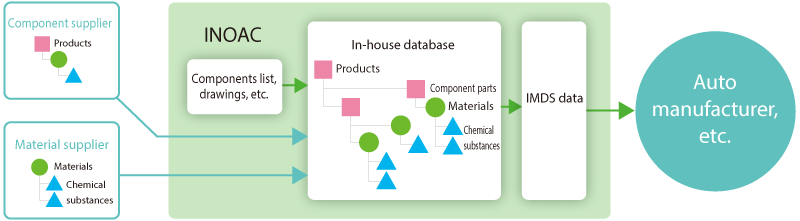
INOAC registers information on chemicals and reports it to our customers through IMDS*1, particularly in the automotive field which is our main field of business. We have a management system to obtain the necessary information via our supply chain and to register the information into IMDS. We also collect information and report it to our clients using the chemSHERPA*2 format, which is widely used in the industrial world, especially the electrical machinery industry.
- IMDS (International Material Data System): A database for transmitting and obtaining information on materials and chemicals over the internet for the automotive industry, which was originally developed to comply with the EU ELV Directive.。
- chemSHERPA: A unified format to transmit information on chemicals contained in products in the supply chain, which the Ministry of Economy, Trade and Industry took the initiative in developing.
Creating an in-house database
The Automotive Division and the Foam Products Division are creating an in-house database through which information on chemical substances contained in parts and materials purchased from suppliers is identified based on information about chemical substances, and centrally managed. This has allowed us to be certain of our compliance with laws and regulations on chemical substances and client requirements which increase each year, while also helping to improve the efficiency and the reporting accuracy of information we register in IMDS and when examining the chemical substances contained in our products.
Establishment and implementation of green procurement criteria
We ascertain what chemical substances are regulated by laws, regulations, and by our customers, based on which we create our green procurement criteria - a list of those chemical substances that we should work to reduce. We present these criteria to suppliers and use them to obtain information on chemical substances contained in raw materials to be purchased. We are also consistently monitoring the latest regulatory developments, based on which we revise these criteria once each year.
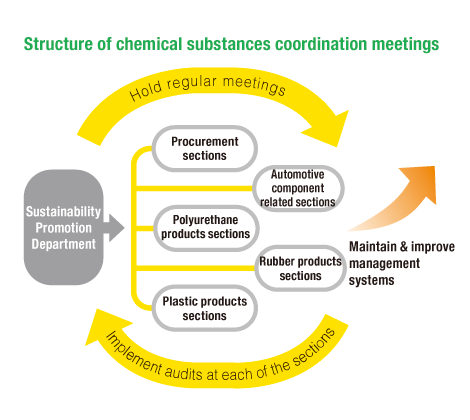
Communication about chemical substance management
With the Environment Section playing a central role, the sections responsible for managing chemical substances in every business division gather for internal chemical substances coordination meetings held once every three months. Activities in the meetings include revising the Green Procurement Standards, reviewing the management structure and operational rules, and sharing opinions on the latest trends in chemical substance regulations such as the REACH regulation and RoHS Directive. We also regularly audit the management structure in each business division as we strive to maintain and improve these organizational structures.
Training for emergencies
We identify accidents and emergencies according to the characteristics of each business facility, and periodically conduct training to prevent and stop the spread of environmental pollution resulting from earthquakes, fires and leakage of oils and raw materials. For the Yana Plant (in Aichi) we hold disaster prevention training (evacuation & extinguishing fires) every March and November. Meanwhile, in manufacturing sections we conduct raw material spill/runoff prevention training at a different location each year. We also prepare for emergencies in other facilities by conducting regular training for emergencies and urgent circumstances.